What Email Automation Means
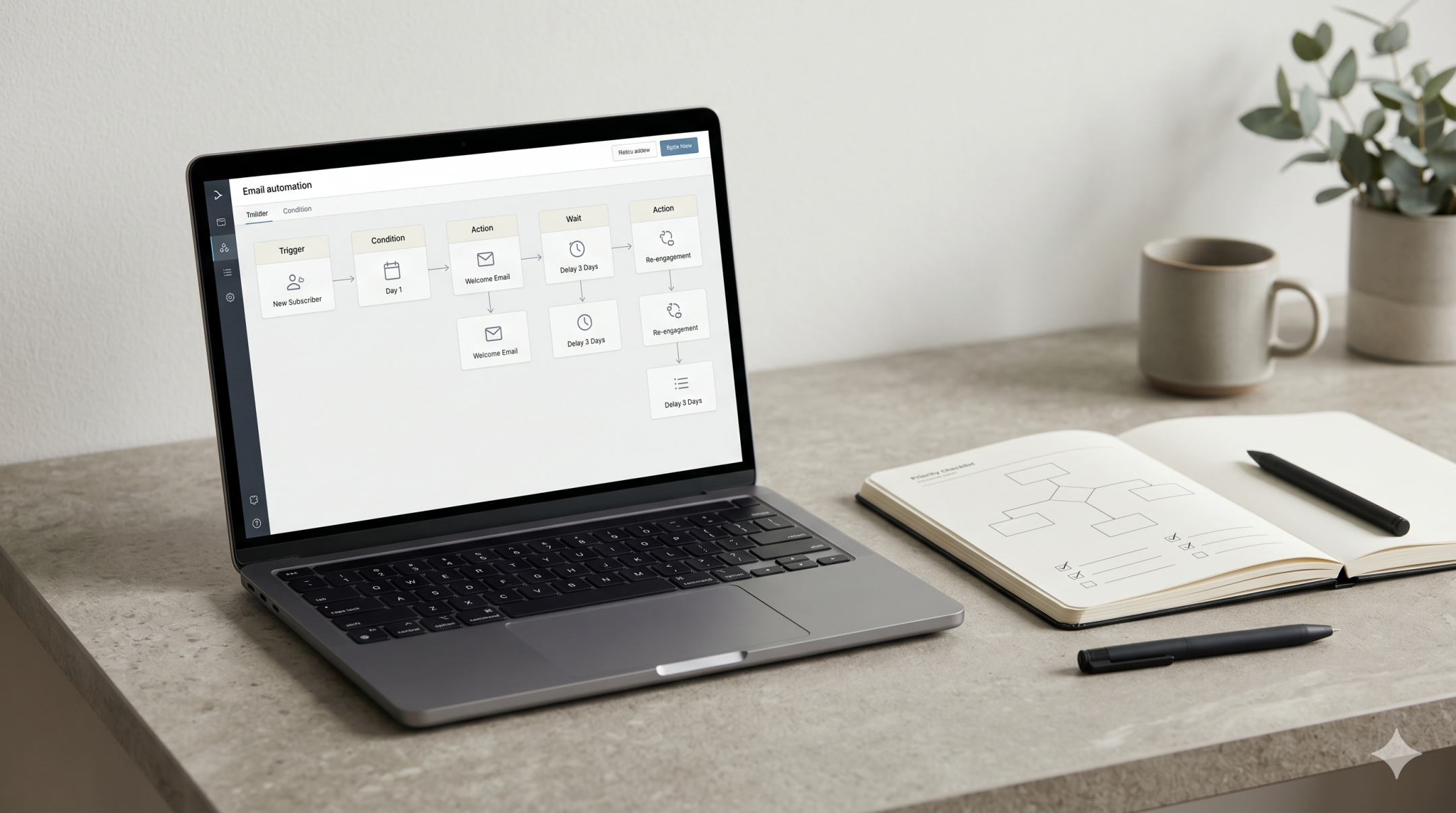
Email automation is the practice of sending emails based on specific triggers, actions or timing without manually creating every message each time. That might include a welcome email after sign-up, a follow-up after a download, a reminder after inactivity or a post-purchase message after an order.
At its best, email automation is not just about efficiency. It is about relevance. Instead of treating every subscriber the same, automated emails respond to what someone has done, where they are in the journey and what they may need next.
This is why email automation sits at the centre of strong lifecycle marketing. It helps businesses deliver communication that feels more timely, more useful and more connected to real customer behaviour.
Why Prioritisation Matters in Automation
One of the most common mistakes in email automation strategy is trying to build everything at once. Businesses often rush into multiple flows, complex triggers and layered segmentation before they have identified which messages actually matter most.
That usually creates three problems.
First, the automation setup becomes harder to manage than expected. Second, the quality of the messaging drops because too much is being built too quickly. Third, teams end up automating for internal convenience rather than customer value.
Prioritisation matters because not all automations have equal impact. Some flows support first impressions, lead progression, retention automation and repeat conversion far more than others. Starting with the highest-value moments helps businesses build an automation system that is useful, measurable and easier to improve over time.
A smarter approach is to begin with the touchpoints that shape the customer journey most clearly:
- when someone first joins your list
- when someone shows interest but is not yet ready to buy
- when someone stops engaging
- when someone has already converted
These are often the best places to start because they connect directly to attention, trust and retention.
The First Email Automations Most Businesses Should Build
Welcome Flow
The welcome flow is usually the first and most important email automation a business should build. It is often the first direct conversation after someone subscribes, signs up or joins a mailing list.
A strong welcome flow does more than say hello. It introduces the brand clearly, sets expectations and helps a new subscriber understand what kind of value they will receive. This may include:
- a clear introduction to the business
- useful content or resources
- product or service context
- what emails they can expect next
- a simple next step
This flow matters because attention is highest at the start. If the first interaction is vague, generic or delayed, momentum is lost quickly. If it is clear and well structured, it can build trust early and move people naturally toward deeper engagement.
For service businesses, the welcome flow can also reinforce expertise by linking to relevant insights, service pages or useful educational content. For product-based brands, it can introduce bestsellers, categories or brand values in a more considered way than a one-off campaign.
Lead Nurture Flow
Not every lead is ready to act immediately. This is where automated email flows for nurturing become important. A lead nurture flow helps move people from early interest to clearer consideration over time.
This flow is especially useful when the sales cycle is longer, the service is more considered or the product requires more understanding before action. Instead of pushing for conversion too early, it builds confidence progressively.
A lead nurture flow might include:
- educational content that answers common questions
- examples of how the service or product solves a problem
- insights that build trust and credibility
- explanations that reduce hesitation
- gentle prompts toward enquiry or purchase
The purpose is not to overload subscribers with information. It is to create a logical sequence that helps people move forward when they are ready. Good marketing automation emails support decision-making. They do not pressure it.
For many businesses, this flow becomes one of the most valuable parts of a broader email automation strategy because it connects audience interest with more deliberate communication over time.
Re-Engagement Flow
Every list includes subscribers who stop opening, clicking or responding. That does not always mean they are no longer valuable. It often means the business needs a better way to reintroduce relevance.
A re-engagement flow is one of the most important forms of retention automation because it gives inactive contacts a reason to reconnect before they are lost completely.
A good re-engagement flow can:
- acknowledge a period of inactivity
- remind the subscriber what value the brand offers
- present useful or timely content
- invite them to update preferences
- offer a simple reason to return
This kind of flow matters because email performance is not only about acquisition. It is also about maintaining engagement quality over time. Without re-engagement planning, lists often become bloated, performance weakens and reporting becomes less useful.
The goal is not to force every inactive subscriber back into the funnel. It is to identify who can be reactivated, who needs a different message and who may no longer be a fit.
Post-Purchase Flow
Many businesses focus so heavily on acquisition that they overlook what happens after a conversion. This is a missed opportunity. The period after purchase is one of the most important moments for strengthening trust, reducing doubt and encouraging repeat action.
A post-purchase flow should not be limited to a receipt or basic confirmation. It should help customers feel informed, supported and more connected to the brand.
Depending on the business, this flow may include:
- confirmation and reassurance
- onboarding or usage guidance
- delivery expectations
- helpful follow-up content
- cross-sell or repeat-purchase prompts at the right time
- review or feedback requests
This is where retention automation becomes especially valuable. A strong post-purchase sequence can improve customer experience, increase lifetime value and make future communication more relevant.
For service businesses, post-conversion emails may support onboarding, expectation setting or next-step clarity. For product brands, they may support product use, care, replenishment timing or related recommendations.
Common Email Automation Mistakes
Automation can be powerful, but it often underperforms for the same reasons.
One common mistake is starting with tools instead of journey logic. Businesses build flows because the platform allows it, not because the sequence reflects a real customer need.
Another issue is automating too much too early. When every possible trigger becomes a separate flow, the system becomes fragmented. Messaging overlaps, priorities become unclear and the experience starts to feel mechanical.
Poor messaging is also a problem. Automation does not make weak email content stronger. If the emails are generic, repetitive or disconnected from user intent, the fact that they are automated will not improve results.
Lack of coordination is another risk. Automated email flows should work together as part of a wider communication system. If welcome, nurture, re-engagement and post-purchase messages all operate in isolation, the customer experience becomes inconsistent.
Finally, many businesses fail to review performance properly. Automation is not something to set once and ignore. Open rates, click behaviour, conversion patterns and drop-off points all help reveal whether the flow is doing its job.
What Smarter Automation Planning Looks Like
Smarter email automation planning begins with the customer journey, not the software. Before building flows, businesses should identify the moments where communication matters most and ask a few practical questions:
- What is the user trying to do at this stage?
- What information would help them move forward?
- What hesitation or uncertainty may exist here?
- What action should this email support next?
This approach usually leads to simpler, more effective automation. It helps teams focus on value first, then structure flows around actual behaviour and business priorities.
A strong email automation strategy often includes:
- clear flow purpose for each sequence
- consistent messaging across the journey
- triggers based on meaningful user actions
- realistic prioritisation
- room for testing and refinement
It also means knowing what not to automate yet. Businesses do not need a large automation library from day one. They need the right flows in the right order.
In many cases, welcome, nurture, re-engagement and post-purchase flows provide the strongest starting foundation. Together, they support acquisition, consideration, retention and repeat engagement without overcomplicating the system.
FAQs
What is the best first step in email automation?
For most businesses, the best first step is a welcome flow. It supports first impressions, sets expectations and creates an immediate, relevant touchpoint after sign-up.
How many automated email flows should a business start with?
Most businesses should begin with a focused set of core flows rather than trying to automate everything. Four strong starting points are welcome, lead nurture, re-engagement and post-purchase.
What makes automated email flows effective?
Effective automated email flows are timely, relevant and clearly tied to customer behaviour. They should have a defined purpose, useful messaging and a logical next step.
Is email automation only useful for e-commerce brands?
No. Email automation works for both service businesses and product brands. The use cases differ, but the principle is the same: send more relevant communication based on real customer actions and stages.
How often should email automations be reviewed?
Automations should be reviewed regularly. This helps businesses spot weak points, improve performance and keep messaging aligned with changing customer behaviour or business priorities.
Final Thoughts
Email automation works best when it reflects how customers actually move, think and decide. The goal is not to build the most complex system. It is to create communication that feels timely, useful and connected to the moments that matter most.
For most businesses, the right place to begin is with a small number of high-impact flows. A welcome flow, lead nurture flow, re-engagement flow and post-purchase flow can create a strong foundation for better lifecycle communication and more sustainable growth.
If your business is reviewing where to start with email automation, it often makes sense to begin with the flows that create the most value first, then build from there with clearer strategy and stronger customer logic.