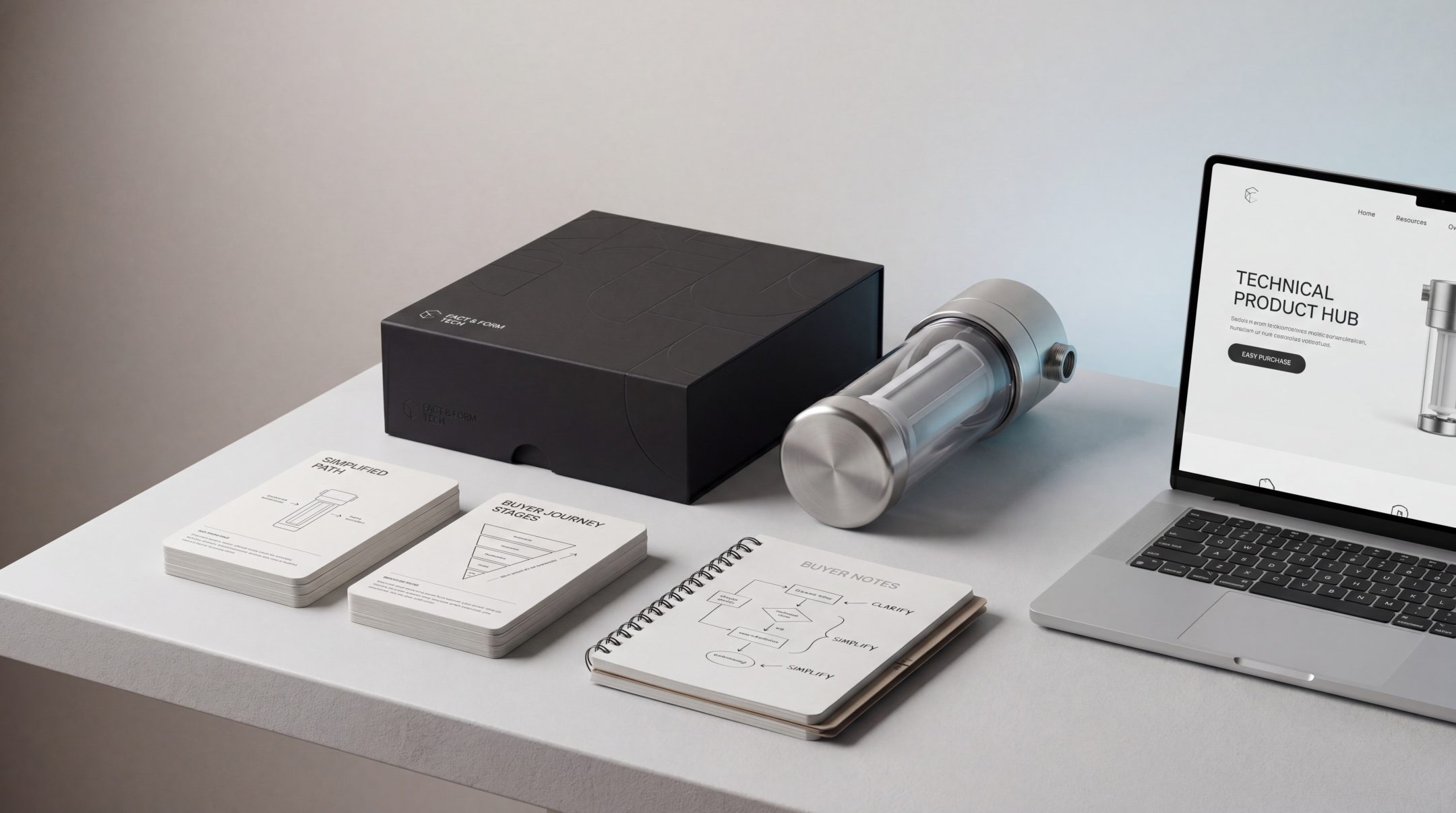
Technical products often have real value, but that value is not always easy for buyers to see quickly. Technical product marketing helps brands explain complex offers with more clarity, structure and confidence, so buyers can understand what the product does, why it matters and why it is the right choice.
Why Technical Product Marketing Matters
Technical product marketing matters because complex products are rarely bought on first impression alone. Buyers need to understand performance, compatibility, quality, credibility, use cases and long-term value before they feel ready to act.
This is especially important in categories such as water filtration, industrial systems, technical components, medical-adjacent products and B2B equipment. The offer may be strong, but the buying decision can become difficult if the brand relies too heavily on specifications, jargon or dense product explanations.
Good technical product marketing creates a bridge between the product and the buyer. It does not remove technical detail. Instead, it organizes it in a way that helps people make sense of the offer faster.
For technical brands, clearer communication can support:
- Faster product understanding
- Stronger perceived credibility
- Better comparison against alternatives
- More confident sales conversations
- Clearer website and packaging journeys
- Better alignment between brand, product and commercial teams
In water filtration, for example, buyers may need to understand performance claims, filter stages, certifications, maintenance needs and product suitability. Strong buyer confidence depends on how clearly those details are communicated, not only on how technically advanced the product is.
What Makes Complex Products Harder to Sell
Complex products are harder to sell because buyers usually have to process more information before they can make a decision. The problem is not always the product itself. It is often the way the product is structured, explained and presented.
A technical product may be difficult to sell when:
- The product benefits are hidden behind specifications
- The website explains features without clarifying use cases
- Product pages are too dense or too vague
- Packaging does not explain what the product does quickly enough
- Claims are not supported by proof or credibility signals
- Similar products are difficult to compare
- Technical terminology is used without enough context
- Sales teams have to explain too much from scratch
In B2B environments, the buying process is often non-linear. Gartner describes the B2B buying journey as a set of buying tasks, including problem identification, solution exploration, requirements building and supplier selection. That matters because technical marketing has to support buyers at each stage, not only at the final conversion point.
A buyer may first need to understand the problem. Later, they may need to compare options. Then they may need evidence, documentation or internal justification. If the brand only communicates through a single sales brochure or a technical spec sheet, it leaves too much work to the buyer.
The Core Requirements of Strong Technical Product Marketing
Strong technical product marketing is built around clarity, structure and proof. It should help buyers move from confusion to understanding, and from understanding to confidence.
Clear Value Proposition
A clear value proposition explains why the product matters in practical terms. It should connect the technical function of the product to a meaningful buyer outcome.
For example, a water filtration product should not only explain its filtration stages. It should also clarify what those stages mean for the buyer, such as better contaminant reduction, improved taste, easier maintenance, longer filter life or suitability for a specific environment.
A strong technical value proposition usually answers:
- What does this product do?
- Who is it for?
- What problem does it solve?
- Why is it different from alternatives?
- What outcome should the buyer expect?
- Why should the buyer trust the claim?
The goal is not to make the product sound simpler than it is. The goal is to make the value easier to recognize.
Simplified Technical Explanation
Technical explanation should be simplified, not diluted. Buyers still need accurate information, but they need it in a format they can understand and use.
This often means turning dense technical information into layered communication. The first layer gives the buyer a quick understanding. The second layer explains how the product works. The third layer provides specifications, documentation or deeper technical detail.
For technical brands, this layered structure can appear across:
- Product pages
- Packaging panels
- Comparison tables
- Explainer diagrams
- Sales decks
- FAQ sections
- Downloadable technical sheets
- Retail or distributor materials
This is where technical product communication becomes a brand asset. It helps the buyer understand value without forcing them to decode the product alone.
Proof and Credibility Signals
Complex products need proof because buyers are often evaluating risk. They may be asking whether the product performs as claimed, whether the brand is credible, whether the product fits their needs and whether the purchase will be easy to justify.
Useful credibility signals can include:
- Certifications
- Testing standards
- Technical documentation
- Product specifications
- Warranty information
- Installation guidance
- Maintenance instructions
- Clear comparison criteria
- Expert explanations
- Transparent performance claims
These signals should be visible at the right point in the buying journey. If proof is buried too deep, buyers may not reach it. If proof is presented without explanation, buyers may not understand why it matters.
Google’s people-first content guidance is useful here because it reinforces a wider principle: content should be genuinely helpful to the user, not only created to attract attention. For technical brands, helpful content often means clear explanations, practical comparison support and evidence that helps buyers make a more confident decision.
Buyer-Friendly Product Structure
Technical brands often struggle when their product range is organized from an internal perspective rather than a buyer perspective. Product families may make sense to engineers, internal teams or distributors, but still feel confusing to new buyers.
A buyer-friendly product structure helps users understand:
- Which product is right for them
- How products differ
- What each model is designed for
- Which specifications matter most
- What accessories, replacements or add-ons are needed
- What to do next
This matters on websites, packaging and sales materials. A strong technical website should not simply list products. It should guide users through product selection, comparison and action. Clear clear buying journeys are especially important when buyers need to evaluate technical details before contacting a supplier or making a purchase.
Common Technical Product Marketing Mistakes
Many technical brands do not have a product quality problem. They have a communication structure problem. The product may be credible, effective and commercially relevant, but the way it is presented makes the offer harder to buy.
Common mistakes include:
Leading with specifications before value.
Specifications matter, but they rarely create understanding on their own. Buyers first need to know why the specification is relevant.
Using internal language instead of buyer language.
Technical teams often describe products according to how they are built. Buyers usually care more about what the product helps them achieve.
Treating all buyers as equally technical.
Some buyers may be engineers or procurement specialists. Others may be business owners, distributors, facility managers or consumers. Strong marketing supports different levels of understanding.
Making comparison difficult.
If buyers cannot easily compare products, models or packages, they may delay the decision or choose a competitor that feels easier to evaluate.
Separating brand, product and sales materials.
Technical marketing becomes weaker when the website says one thing, packaging says another and sales teams explain the offer differently.
Overloading pages with too much information.
More detail is not always more helpful. The issue is hierarchy. Buyers need the right information in the right order.
Underusing visuals.
Technical products often benefit from diagrams, process illustrations, comparison tables, icons, product architecture and simplified system views. Visual clarity can reduce the effort needed to understand the offer.
What Stronger Technical Marketing Looks Like
Stronger technical marketing makes the product easier to understand without making it feel basic. It respects the complexity of the offer, but it structures that complexity around buyer needs.
In practice, stronger execution may include:
- A clear product positioning statement
- A simple explanation of the product’s role
- Benefit-led messaging supported by technical proof
- Product range architecture that helps buyers compare options
- Clear product pages with logical information hierarchy
- Packaging that explains value quickly
- Diagrams that simplify technical processes
- FAQ content that answers real buyer objections
- Consistent sales and marketing language
- Downloadable resources for deeper evaluation
For water filtration and other technical categories, the aim is to make every touchpoint work harder. The packaging should clarify the product. The website should guide evaluation. The sales deck should reinforce the same value proposition. Technical sheets should provide depth without replacing the main message.
This is also where lessons from consumer categories can be useful. Strong product communication is about making value clear quickly, even when the product itself requires deeper explanation. Technical brands do not need to behave like FMCG brands, but they can learn from the discipline of fast, structured communication.
FAQs
What is technical product marketing?
Technical product marketing is the process of turning complex product information into clear, structured and buyer-friendly communication. It connects technical features to practical value, supports buyer education and helps customers understand why a product is relevant, credible and worth choosing.
Why is technical product marketing important for water filtration brands?
Water filtration products often involve technical claims, performance differences, certifications, filter stages and maintenance requirements. Technical product marketing helps organize this information so buyers can understand the product faster and feel more confident in the brand.
How is technical product communication different from general marketing?
General marketing may focus on awareness, brand visibility or campaign messaging. Technical product communication focuses more specifically on explaining how a product works, what makes it valuable, how it compares and what evidence supports the offer.
Should technical brands simplify their messaging?
Yes, but simplification should not mean removing important detail. Strong technical messaging uses layers. It gives buyers a clear first explanation, then provides deeper technical information for those who need it.
What makes a technical product easier to buy?
A technical product becomes easier to buy when the value proposition is clear, the product structure is easy to navigate, claims are supported by proof and the buyer can understand the next step without needing too much explanation from sales.
Final Thoughts
Technical product marketing is not about making complex products feel less serious. It is about making their value easier to understand, compare and trust.
For technical brands, especially in water filtration, strong communication can turn a complicated offer into a clearer buying journey. When messaging, proof, visuals, packaging and website structure work together, buyers do not have to work as hard to understand why the product matters.
Fact & Form helps technical brands shape clearer product messaging, stronger brand communication and more buyer-friendly digital and packaging systems. If your product value is strong but difficult to explain, a more structured communication approach can make it easier for customers to understand and act on.