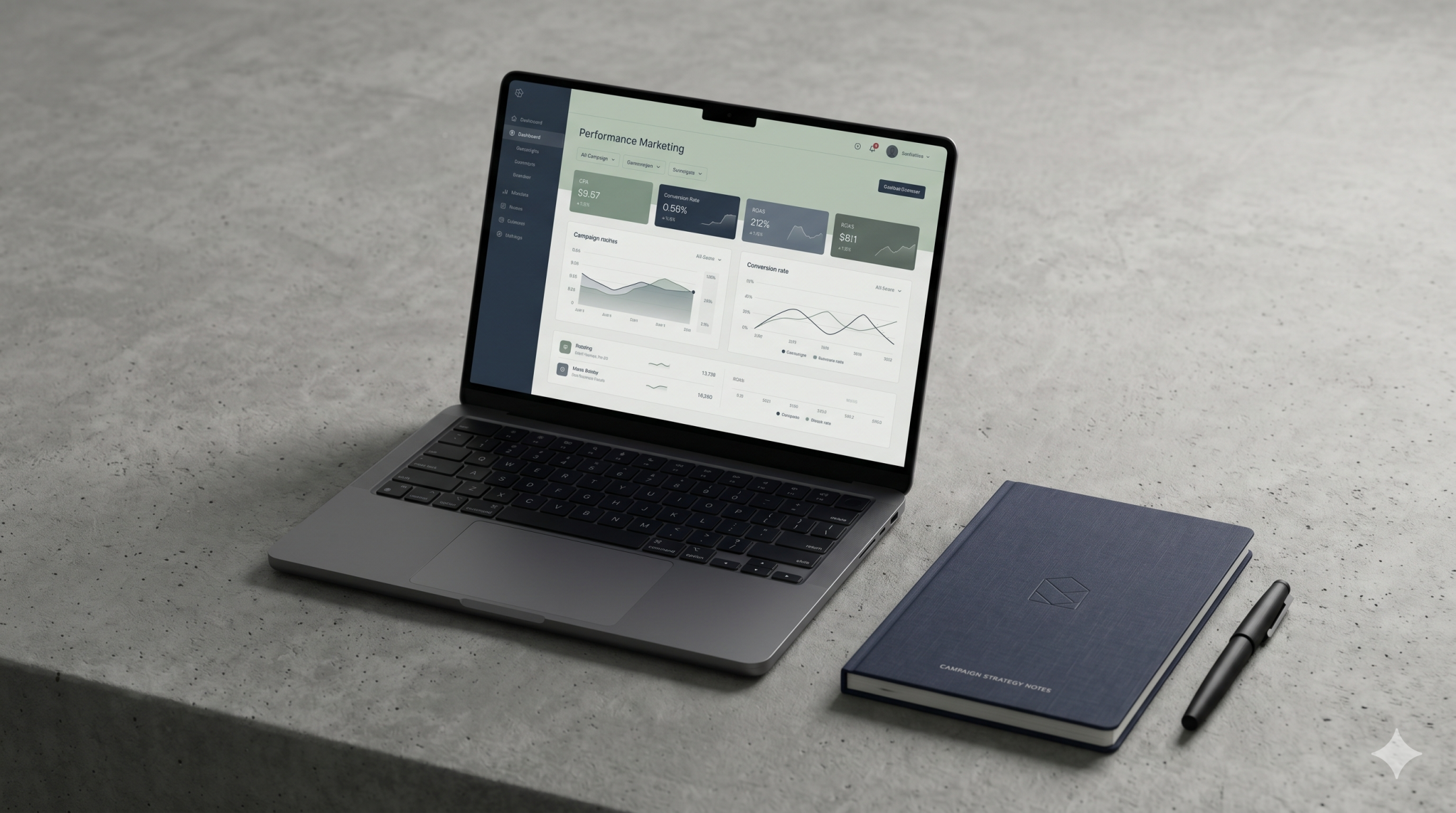
What Performance Marketing Strategy Covers
Performance marketing strategy is the planning behind measurable paid activity. It defines how campaigns should attract the right audience, move people through a buying journey and generate meaningful actions such as enquiries, sign-ups or purchases.
In practice, that means performance marketing covers more than media buying. It includes targeting, offer structure, messaging, creative direction, landing page experience, conversion goals and reporting logic. A campaign may look active on the surface, but without these connected parts it often struggles to scale efficiently.
A better performance marketing strategy asks practical questions early:
- Who are we trying to reach?
- What problem or need are we addressing?
- What message is most likely to matter to that audience?
- Where are we sending traffic?
- What action do we want people to take?
- What could stop them from taking it?
When these questions are answered properly, paid media becomes part of a system rather than a standalone tactic.
Why Paid Media Alone Is Not Enough
Many businesses assume performance marketing is mainly about platform setup, budget management and audience targeting. Those things matter, but they are only part of the picture.
Paid media can generate attention quickly, but attention alone does not create conversion. If the ad sets the wrong expectation, if the creative is weak, or if the landing page feels unclear or disconnected, campaign performance usually suffers. This is often where results flatten out.
A few common examples make this clear:
- A well-targeted campaign drives traffic, but the landing page does not explain the offer clearly enough.
- An ad gets clicks because the headline is strong, but the page design feels generic and trust drops immediately.
- Multiple creatives are tested, but none are built around a clear audience insight or decision trigger.
- Media spend increases, but the post-click experience has too much friction for users to convert.
In each case, the media platform is not the only issue. The full journey needs attention.
That is why effective performance marketing planning treats paid media, creative and landing page performance as connected. Better results usually come from fixing the whole path, not only adjusting bids or budgets.
The Core Elements of Better Performance Marketing
Audience Targeting
Audience targeting is the foundation of any performance marketing strategy. It shapes who sees the ad, how relevant the message feels and how likely users are to act.
Good targeting is not only about demographics or broad interest groups. It should reflect audience intent, pain points, awareness level and decision stage. A person discovering a brand for the first time needs a different message from someone already comparing providers or considering purchase.
Stronger audience targeting usually includes:
- segmenting by intent or level of awareness
- matching offers to audience needs
- understanding what objections may exist
- identifying which channels fit the audience best
When targeting is too broad or too vague, performance often becomes harder to improve because the message has to work for too many different people at once.
Creative Quality
Creative quality has a direct effect on campaign performance because it shapes first impression, relevance and click motivation. In paid media, creative is often the first real interaction a user has with a brand or offer.
Strong creative strategy is not simply about making ads look polished. It is about presenting the right idea in the right format with the right level of clarity. Good creative should help people understand what is being offered, why it matters and why they should care now.
Better-performing creative often has a few shared traits:
- a clear message rather than too many competing points
- relevance to a specific audience need
- visual consistency with the landing page experience
- a direct connection between promise and outcome
- a format suited to the channel and context
Creative quality also improves when teams test meaningful variations. That means changing angles, propositions, calls to action and framing, not just swapping colours or resizing assets.
Landing Page Alignment
Landing page alignment is one of the most overlooked parts of landing page performance. If an ad makes one promise and the page delivers a different experience, conversion friction increases immediately.
Users should feel that the landing page continues the conversation started by the ad. The offer, headline, tone, visuals and call to action should all feel connected. This reduces confusion and reinforces trust.
Strong landing page alignment usually includes:
- headline continuity between ad and page
- consistent offer framing
- relevant supporting content
- clear next-step actions
- page structure built around decision-making, not just appearance
The landing page does not need to be long or complex, but it does need to be purposeful. It should answer the questions a visitor is likely to have before taking action.
Conversion Thinking
Conversion thinking is the discipline of reducing friction and making action easier. It shifts the focus from traffic volume alone to what actually helps users move forward.
This includes more than form design or button placement. It involves understanding the conversion journey as a sequence of decisions. People need clarity, trust and motivation at each step.
Useful conversion thinking often focuses on:
- making value obvious quickly
- prioritising the most important information
- reducing unnecessary distractions
- addressing common objections
- using design and content to guide action clearly
A good campaign does not rely on persuasion alone. It removes avoidable barriers. When conversion thinking is built into the strategy from the start, performance becomes more stable and easier to improve over time.
Common Performance Marketing Mistakes
A weak performance marketing strategy often shows up through recurring execution problems. These are not always dramatic errors, but they quietly reduce efficiency and make campaigns harder to optimise.
One common mistake is treating paid media as separate from the website experience. Ads may be well managed, but the landing page is slow, generic or unclear. This creates a disconnect between acquisition and conversion.
Another mistake is relying on creative that lacks direction. Campaigns often use assets that look acceptable but do not express a sharp message, audience insight or compelling reason to act.
A third issue is weak alignment between targeting and content. Businesses sometimes send very different audience segments to the same page with the same value proposition, even when their needs are not identical.
Other frequent mistakes include:
- prioritising clicks over qualified action
- testing too many minor variables instead of bigger strategic differences
- sending paid traffic to pages designed for general browsing rather than campaign conversion
- failing to build trust signals into the page experience
- scaling spend before the post-click journey is strong enough
These problems are common because they sit between teams. Media, creative and web are often handled separately, even though campaign performance depends on how well they work together.
What Better Paid Media Execution Looks Like
Better paid media execution looks connected, intentional and easier to learn from. Instead of treating campaigns as isolated ads inside a platform, it treats the entire path as one performance system.
That usually means:
- campaign goals are clearly defined
- audiences are segmented with purpose
- creative is built around specific messages and offers
- landing pages are tailored to the campaign context
- conversion paths are simple and measurable
- reporting looks at quality, not just traffic volume
In stronger setups, media and creative teams are not working in isolation from web or content. The ad promise is reflected in the page structure. The page answers the questions the creative raises. The call to action feels like the logical next step rather than a sudden ask.
This also makes optimisation more useful. When campaigns are strategically connected, teams can identify whether performance issues come from targeting, messaging, page clarity, trust, offer strength or conversion friction. That is much more valuable than endlessly adjusting budgets without solving the real issue.
A better performance marketing strategy does not chase efficiency only inside the ad account. It improves the full user journey from impression to action.
FAQs
What is a performance marketing strategy?
A performance marketing strategy is a plan for using paid channels to generate measurable business outcomes. It covers more than ad setup and includes targeting, messaging, creative, landing pages, conversion goals and performance analysis.
Why is creative important in paid media strategy?
Creative matters because it shapes how relevant and compelling the ad feels. It helps attract the right attention, communicate the offer clearly and set expectations for the landing page experience.
How do landing pages affect paid campaign results?
Landing pages affect whether traffic converts. Even strong ads can underperform if the page is unclear, inconsistent with the message or difficult to act on. Better landing page performance often improves results without needing more spend.
What does conversion thinking mean in performance marketing?
Conversion thinking means designing campaigns and landing pages around the user decision process. It focuses on clarity, trust, relevance and reducing friction so users can move toward action more easily.
Why do some paid media campaigns get clicks but not results?
This usually happens when there is a disconnect between targeting, creative, offer and landing page experience. High click volume does not help much if users arrive on a page that does not continue the message or support conversion clearly.
Final Thoughts
A strong performance marketing strategy is not built on paid media alone. Better results usually come from connecting media, creative and landing page performance into one clear system. When targeting is sharper, creative is more relevant and the landing page experience supports decision-making, campaigns become more efficient and more commercially useful.
Businesses often look for quick performance gains inside ad platforms, but the bigger opportunity is often the journey around them. Paid media works better when the full path from ad to landing page to action is designed with intention.
If your campaigns are generating traffic but not enough meaningful results, it may be time to review the wider conversion journey and strengthen the parts around the media spend.