What Customer Journeys Actually Mean
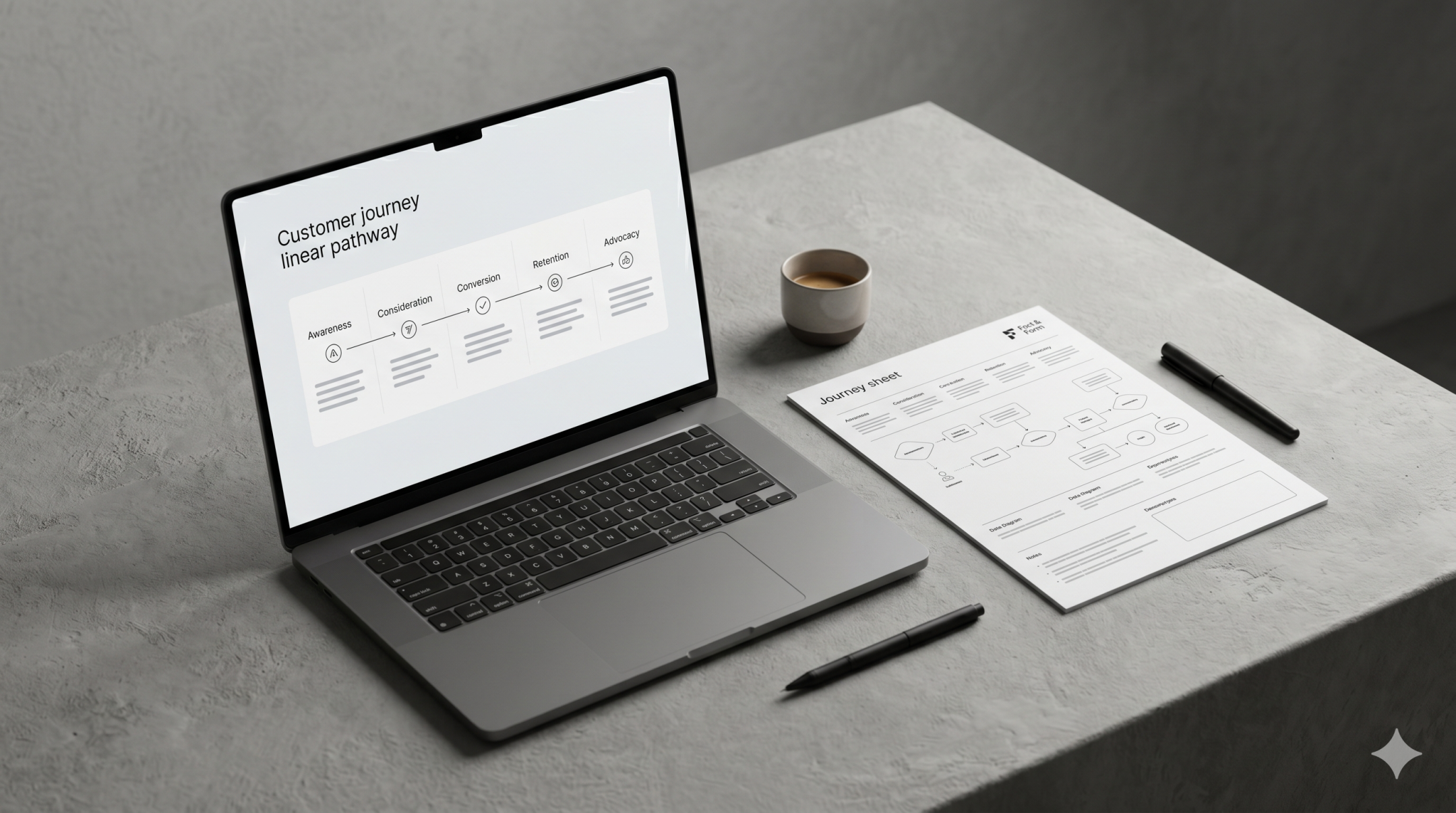
Customer journeys describe the full path people take as they interact with a business across different touchpoints, channels and decisions. That path often begins before a direct enquiry or purchase and continues well after conversion.
A journey is not just a sales funnel viewed from the business side. It is the real experience a person has while discovering, evaluating, buying and continuing to engage with a brand. That includes website visits, email interactions, landing pages, forms, follow-up messages, onboarding flows, support content and retention activity.
This is why customer journeys design matters. It helps businesses look at the experience as a connected system rather than a series of isolated actions. Instead of asking whether one page or one email performs well on its own, the better question is whether the whole experience helps the user move forward with confidence.
In practical terms, user journey mapping helps teams identify where people lose clarity, hesitate, drop off or disengage. That creates a stronger foundation for improving both the conversion journey and the retention journey.
Why Journey Design Matters
Better journey design improves performance because it reduces friction. People are more likely to act when they understand where they are, what comes next and why it matters.
In many businesses, conversion problems are not caused by a single weak message. They are caused by small disconnects across the journey. A campaign may attract the right audience, but the landing page may not match the promise. A form may be too demanding too early. A purchase may happen, but follow-up communication may be generic or poorly timed. Each friction point weakens momentum.
Good customer journeys design helps solve this by improving continuity between touchpoints. Messaging becomes more aligned. Pages become more purposeful. Email flows become more relevant. The overall path becomes easier to move through.
This matters for two reasons.
First, it supports conversion. People are more likely to enquire, subscribe, book or buy when the path feels clear and logical.
Second, it supports retention. Once someone becomes a customer, the experience still needs structure. Retention is rarely the result of one follow-up email alone. It is usually the result of a consistent retention journey that keeps the relationship useful, relevant and easy to continue.
The Core Stages of a Better Customer Journeys
Discovery
The discovery stage is where people first become aware of a business, offer or problem worth solving. This may happen through search, social content, paid media, referrals, organic content or email.
At this stage, clarity matters more than complexity. People need to understand quickly what the business does, who it helps and why it is relevant. If the first touchpoint is vague, overly broad or disconnected from the audience’s actual need, the journey becomes weaker immediately.
Good journey design at the discovery stage usually includes:
- clear messaging that reflects real audience intent
- landing pages or website entry points that match the source of traffic
- useful content that helps users understand the topic or offer
- a consistent handoff between campaign, page and next action
A strong discovery experience does not try to do everything at once. It gives people a clear reason to keep moving.
Evaluation
In the evaluation stage, people compare options, assess trust and decide whether a business feels right for them. This is where the experience often becomes more detailed and more vulnerable to friction.
Users may explore service pages, case examples, FAQs, product details, reviews, email sequences or supporting content. They are looking for enough clarity to reduce uncertainty.
This stage is often weakened by missing information, inconsistent messaging or unclear paths to the next step. For example, a website may explain services well but fail to show what happens after enquiry. An email sequence may be well written but not matched to the user’s actual interest or decision stage.
Better customer journey design at the evaluation stage focuses on:
- answering likely objections early
- presenting information in a clear order
- building trust through consistency and relevance
- making next steps visible without pressure
A better conversion journey depends heavily on this stage. People rarely convert because of a single push. More often, they convert because the evaluation experience steadily reduces doubt.
Conversion
The conversion stage is where interest turns into action. That action may be a purchase, a booking, a form submission, a consultation request or another meaningful step.
This is where many businesses focus most of their energy, but conversion performance usually reflects what came before it. If discovery and evaluation have been weak, conversion friction rises.
The most common issues at this stage are practical rather than dramatic. Too many steps. Unclear forms. Confusing calls to action. Weak reassurance. Sudden changes in tone or offer. Missing confirmation after action is taken.
Good journey design supports conversion by making the final step feel simple, expected and low-friction. That often means:
- keeping forms or checkout flows focused
- removing unnecessary decisions
- reinforcing value at the point of action
- confirming what happens next immediately after conversion
A strong conversion journey does not rely on pressure. It removes uncertainty and helps users complete the action they were already considering.
Retention
Retention is where many businesses underinvest, even though this stage often has the strongest long-term commercial value. Once someone becomes a customer, the journey should not stop. This is the point where trust is either reinforced or gradually lost.
A good retention journey keeps the relationship active through useful communication, thoughtful timing and relevant follow-up. In email strategy especially, retention is often shaped by what happens after the first conversion, not just before it.
This could include onboarding emails, service updates, educational content, replenishment reminders, account support, re-engagement sequences or value-led lifecycle messaging.
Better retention journey design helps businesses:
- set clear expectations after purchase or sign-up
- maintain relevance over time
- create useful touchpoints instead of generic contact
- support repeat actions and long-term loyalty
Retention grows when people feel supported, not forgotten. Good journey design helps make that support consistent.
Common Journey Design Mistakes
Many customer journeys underperform because they were never designed as a full experience. They evolved in fragments across teams, channels and short-term priorities.
Some of the most common issues include:
Designing channels separately
A website, email flow and campaign may each work reasonably well on their own, but still create a poor overall experience if they are not aligned. Customer journeys break down when touchpoints feel disconnected.
Focusing only on acquisition
Businesses often invest heavily in getting attention and not enough in what happens after. This weakens both conversion and retention because the experience becomes front-loaded and incomplete.
Asking for too much too early
Many journeys create friction by pushing users into complex forms, hard commitments or detailed decisions before enough trust has been built.
Ignoring real user questions
Journey design often reflects internal assumptions rather than actual audience concerns. If messaging and content do not answer what people need at each stage, drop-off becomes more likely.
Treating email as an afterthought
Email is often one of the most important channels in a conversion journey and retention journey, yet it is frequently added late or used inconsistently. Strong lifecycle marketing depends on email being planned as part of the full journey, not as a separate layer.
Measuring touchpoints without measuring flow
A page may have strong engagement and an email may have decent open rates, but the journey can still underperform if people are not progressing smoothly from one stage to the next.
What Better Journey Execution Looks Like
Better journey execution starts with seeing the experience from the customer’s side. That means understanding what users need, what they are trying to achieve and what might stop them at each stage.
In practice, stronger customer journeys design usually includes the following:
Clear stage-based thinking
Different users need different information depending on where they are in the journey. Discovery content should not behave like conversion content. Retention messaging should not sound like acquisition messaging.
Consistent messaging across touchpoints
When campaigns, pages and emails reinforce the same value clearly, users feel more confident moving forward.
Reduced friction at key moments
Small design and content improvements can have a major impact. Better forms, clearer calls to action, more relevant follow-up and stronger page structure all help remove barriers.
Better use of email in the journey
Email can guide users through evaluation, support conversion and strengthen retention when it is used with clear purpose. This is where lifecycle marketing becomes especially valuable. It helps businesses create connected, stage-aware communication rather than one-size-fits-all messaging.
Ongoing journey review
Customer journeys are not static. They should be reviewed, mapped and improved over time as audience needs, channels and offers evolve. User journey mapping helps teams identify gaps and make more informed decisions about structure, messaging and experience design.
FAQs
What is the difference between a customer journey and a sales funnel?
A sales funnel is often described from the business perspective and focuses on moving leads toward conversion. Customer journeys are broader and reflect the full user experience across awareness, evaluation, action and retention.
Why do customer journeys matter for email strategy?
Email often connects multiple stages of the journey. It can support awareness, nurture evaluation, encourage conversion and maintain retention. Without a clear journey behind it, email strategy tends to become reactive and less effective.
How does user journey mapping help improve conversion?
User journey mapping helps identify where people become confused, lose trust or drop off. Once those friction points are visible, businesses can improve the path more effectively.
Are customer journeys designs only relevant for e-commerce?
No. Customer journeys matter for service businesses, lead generation websites, subscription models, digital products and any business where people move through multiple touchpoints before and after action.
What is a retention journey?
A retention journey is the post-conversion experience that keeps customers engaged, supported and more likely to return. It often includes onboarding, follow-up communication, education and re-engagement activity.
Final Thoughts
Customer journeys are not just diagrams or marketing theory. They are the real paths people take when deciding whether to trust, choose and stay with a business. When those paths are clearer, conversion usually improves. When they continue to feel useful after action, retention tends to improve too.
Better journey design is really about reducing friction and increasing relevance across the moments that matter most. That is what turns disconnected touchpoints into a stronger customer experience.
If your current journey feels harder to move through than it should, it may be time to review the path more closely. A clearer structure across web, email and lifecycle touchpoints can make a meaningful difference to both conversion and retention.