Why On-Page SEO Matters for Service Businesses
Service-based websites usually rely on a relatively small number of commercially important pages. Unlike large ecommerce sites with hundreds of product pages, service businesses often depend on a tighter group of pages to generate enquiries, consultations or leads.
That makes on-page SEO especially important.
If a service page is vague, poorly structured or disconnected from the rest of the site, it becomes harder for search engines to understand its purpose and harder for users to trust what they are reading. Even strong services can underperform if the page itself does not explain the offer clearly.
Good on-page SEO helps service businesses:
- improve relevance for target search terms
- create clearer page structure for users and search engines
- strengthen the relationship between services, industries and supporting content
- improve visibility for key commercial pages
- support better user experience and conversion clarity
In practical terms, on-page SEO is where content, structure and search intent meet. It turns a basic page into a more useful, more understandable and more competitive asset.
The Most Important On-Page SEO Best Practices
Titles and Headings
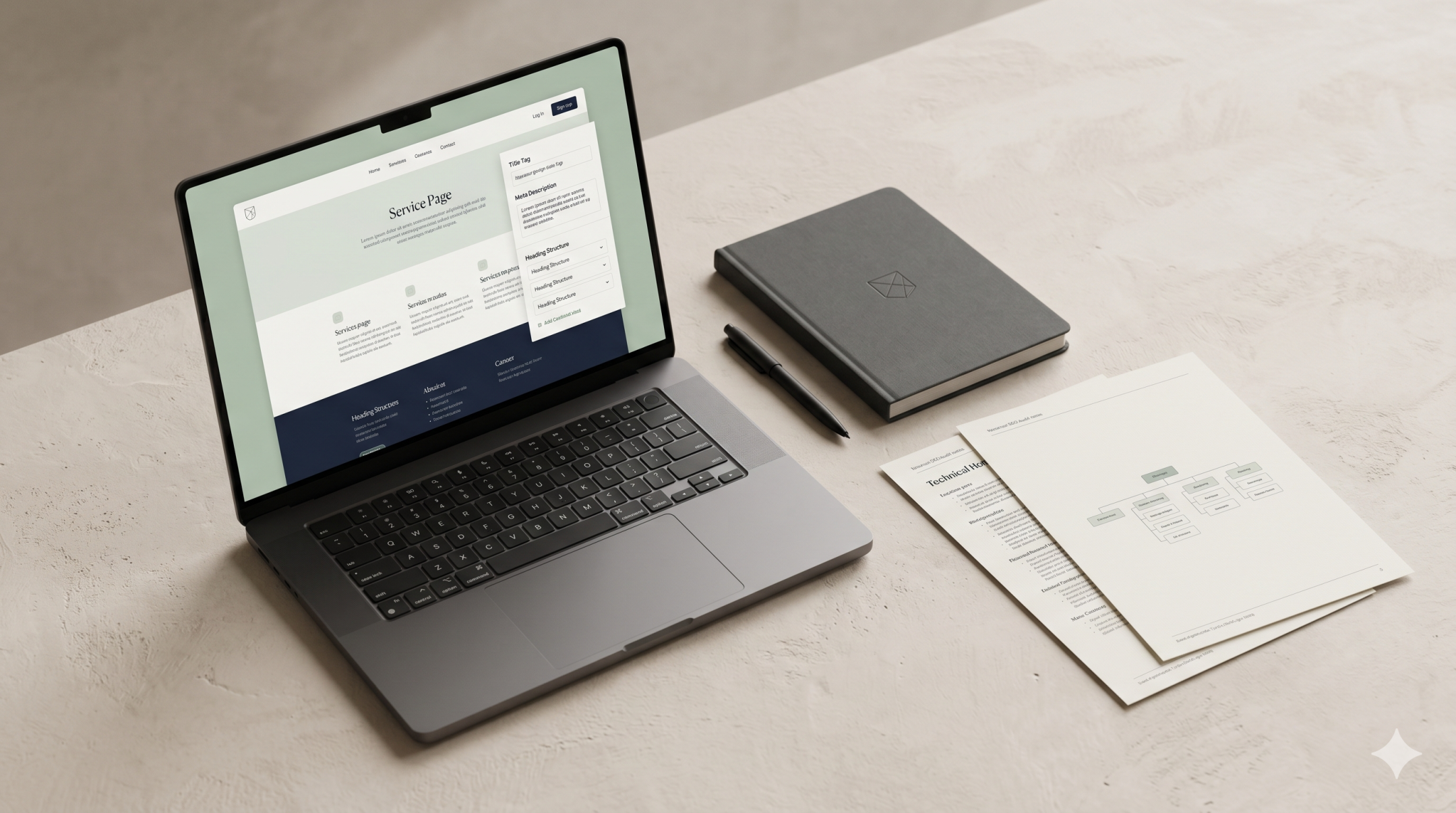
Page titles and headings are among the most important signals on any service page. They shape how both users and search engines understand the page.
The title tag should clearly describe the page topic and align with the target keyword naturally. For a service business, that usually means being direct rather than clever. A page called “Technical SEO Services for Growing Businesses” is far more useful than a vague headline that only makes sense internally.
The H1 should also reflect the main topic clearly. In most cases, the H1 and title tag should be closely aligned, even if they are not identical.
Below that, H2 and H3 headings should organise the page logically. They should not be added just for SEO value. They should help break the page into understandable sections such as:
- what the service is
- who it is for
- what problems it solves
- how the process works
- what outcomes clients can expect
This makes the page easier to scan, easier to interpret and easier to rank for related search intent.
Content Relevance
One of the most overlooked on-page SEO best practices is simple relevance. Many service pages mention a keyword, but do not actually cover the subject in enough depth to deserve visibility.
Relevant content should answer the questions a potential client is likely to have. It should explain the service in plain language, clarify its business value and show why it matters. That does not mean every page needs to be long. It means every page needs to be focused and complete.
For service website SEO, relevance often depends on covering the basics well:
- what the service includes
- who the service is designed for
- how the process works
- what makes the approach effective
- how this service connects to wider business goals
A page about web strategy, for example, should not only mention strategy as a phrase. It should explain what strategy means before design begins, why structure matters and how that affects project outcomes.
Search engines increasingly reward pages that satisfy intent, not just pages that repeat a phrase.
Internal Linking
Internal linking is one of the most useful and underused parts of on-page SEO. It helps search engines understand the relationship between your pages, while also helping users move through the site more naturally.
For service businesses, internal links should create clear pathways between:
- main service pages
- related sub-services
- industry-specific pages
- blog articles that support the same topic
- relevant process or strategy pages
For example, a page about on-page SEO should logically link to related pages about SEO strategy, technical SEO, content strategy or web development. That creates stronger topical context and gives users a more connected journey.
The key is relevance. Internal links should support understanding, not clutter the page. Anchor text should be descriptive and natural, so users know what to expect when they click.
Page Structure
Strong SEO page structure makes content easier to interpret. Search engines do not just look at keywords. They also read how information is organised.
A well-structured page usually has:
- one clear H1
- a logical H2 and H3 hierarchy
- concise sections focused on one topic at a time
- readable paragraph lengths
- clear supporting elements such as bullet points, FAQs or process summaries where useful
For service pages, structure is especially important because users are often comparing providers, scanning quickly and looking for reassurance. If a page feels crowded, repetitive or hard to navigate, both readability and trust can suffer.
Good page structure also supports conversion. A user should be able to understand the offer, follow the logic of the page and find the next step without friction.
Metadata
Metadata is not the whole SEO picture, but it still matters. The title tag and meta description often shape how a page appears in search results, which can affect visibility and click-through behaviour.
A strong title tag should:
- reflect the page topic clearly
- include the target keyword naturally
- stay concise and readable
- describe the service or value without sounding forced
A strong meta description should support the title by explaining what the page covers and why it is useful. It should be clear, specific and written for humans first.
Metadata is especially important on service websites because commercial pages need to compete not only for rankings, but also for attention. A vague or generic title can weaken performance before the user even reaches the page.
Common On-Page SEO Mistakes
Over-optimised Pages
One of the most common mistakes is treating on-page SEO like a keyword-placement exercise. This often leads to awkward headings, repetitive phrasing and content that sounds unnatural.
Over-optimised pages usually have symptoms such as:
- the same keyword repeated too often
- headings written for search engines rather than readers
- thin paragraphs padded with keyword variations
- metadata that reads like a list of terms instead of a clear message
This weakens both readability and credibility. Service pages should sound expert and human, not mechanical.
A better approach is to centre the page around the core topic, then support it with natural language, related terminology and useful explanation.
Weak Service Messaging
Another major issue is weak messaging disguised as SEO work. Some pages include the right keywords but still fail because the service itself is not explained clearly.
This often happens when pages are too generic. They talk broadly about growth, solutions or results without showing what the business actually does. Search engines may struggle to understand the page, but users certainly will.
Weak service messaging usually looks like:
- unclear descriptions of the service
- vague promises without detail
- too much agency language and not enough clarity
- missing information about process, scope or value
On-page SEO is strongest when content clarity and optimisation work together. The keyword brings focus, but the message gives the page meaning.
How Service Websites Should Apply These Best Practices
The most effective way to apply on-page SEO best practices is not to treat every page the same. Different page types serve different purposes.
Homepage content should clarify what the business does, who it helps and where visitors should go next. Service pages should focus on one service clearly and in enough depth. Industry pages should connect the service to specific sector needs. Blog articles should support broader intent, answer related questions and strengthen internal linking.
For most service websites, a practical approach looks like this:
Start with the core commercial pages
Begin with the pages that matter most to lead generation and service visibility. These are usually:
- main service pages
- priority sub-service pages
- location or sector-specific landing pages
- homepage and key overview pages
Improving these pages first usually creates the biggest commercial value.
Match each page to a clear search intent
Every important page should have a defined purpose. Ask what the user is actually looking for. Are they trying to understand a service, compare providers, evaluate options or solve a specific problem?
The page should reflect that intent in its content, structure and language. Informational intent needs education. Commercial intent needs clarity, confidence and a stronger next step.
Strengthen structure before expanding content
Longer content does not always mean better performance. In many cases, structure is the first issue to fix.
Before adding more copy, review whether the page already has:
- a clear H1
- useful section headings
- a logical flow
- concise, readable content blocks
- obvious internal linking opportunities
A well-organised page often performs better than a longer but unfocused one.
Build connected topic pathways
Service pages should not sit in isolation. Connect them to related blog content, supporting strategy pages and technical pages where relevant.
For example, a page on web development might link to content on UX strategy, CMS development or website redesign. A page on content strategy might link to keyword research, search intent analysis and topic clustering.
This makes the site stronger as a system, not just as a set of individual URLs.
Review pages regularly
On-page SEO is not a one-time task. Service offerings evolve, messaging changes and websites grow. Important pages should be reviewed regularly to ensure they still reflect the business clearly and still support current search priorities.
That review should look at:
- keyword alignment
- content clarity
- heading structure
- metadata quality
- internal linking opportunities
- consistency with current services and positioning
FAQs
What is on-page SEO for a service-based website?
On-page SEO for a service-based website is the process of improving page content, headings, metadata, internal links and structure so search engines and users can understand the service more clearly. It focuses on making key pages more relevant, useful and visible.
Which pages matter most for service website SEO?
The most important pages are usually the homepage, main service pages, priority sub-service pages, industry-specific pages and high-value landing pages. These are often the pages closest to enquiry or conversion.
How important are headings for on-page SEO?
Headings are very important because they help define topic structure and improve readability. A strong H1, followed by clear H2 and H3 sections, makes it easier for users and search engines to understand what the page covers.
Should every page target a different keyword?
In most cases, yes. Each core page should have a primary focus so it serves a distinct purpose. Pages can still support related terms naturally, but too much overlap between pages can weaken clarity and create internal competition.
Is metadata still important for SEO?
Yes. Metadata, especially title tags and meta descriptions, helps shape how pages appear in search results. Strong metadata improves relevance, clarity and search visibility, even though it is only one part of broader website optimization.
Can good on-page SEO improve conversions too?
Yes. Better on-page SEO often improves conversion performance because it creates clearer messaging, stronger structure and easier user journeys. When people understand the service more quickly, they are more likely to take the next step.
Final Thoughts
The best on-page SEO best practices are usually the most practical ones. Clear titles, useful headings, relevant content, strong internal linking and well-structured pages do far more for service website SEO than keyword stuffing or surface-level edits.
For service businesses, the goal is not just to rank. It is to create pages that explain the offer clearly, support trust and connect users to the next step with less friction. That is where on-page SEO becomes commercially valuable.
If your core website pages are not performing as well as they should, it may be worth reviewing whether the issue is traffic alone or whether the page structure, messaging and optimisation need to be stronger. Clearer, better-connected pages often create better visibility and better outcomes at the same time.