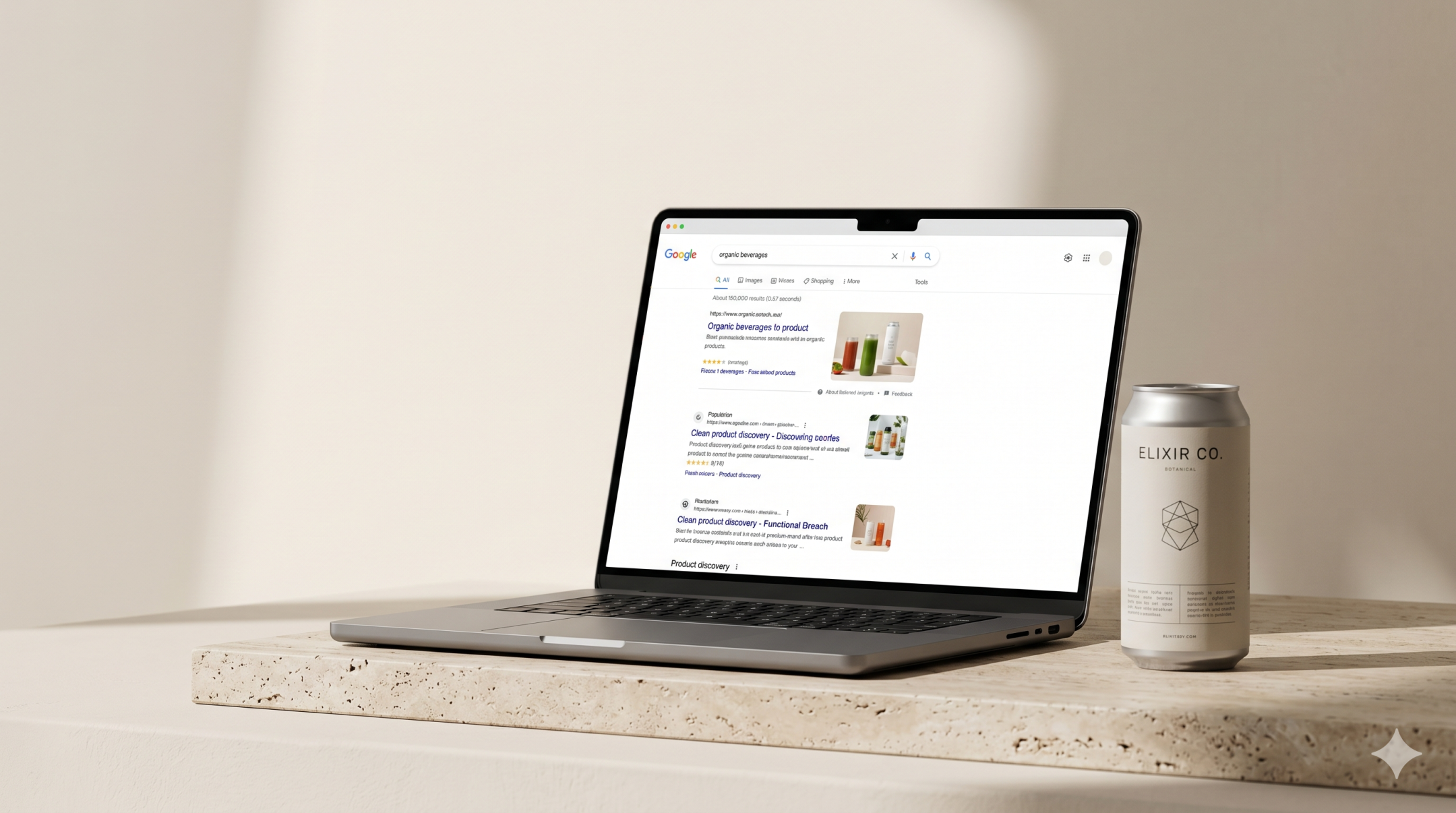
Why SEO Matters for FMCG Brands
FMCG categories move fast. Consumers make quick decisions, product ranges change regularly and competition is constant across shelves, marketplaces and digital channels. Because of that, many brands focus heavily on paid visibility. Paid campaigns can be useful, but they stop working the moment spend stops.
SEO gives FMCG brands a different kind of value. It helps build discoverability that continues beyond campaign windows and supports people at multiple stages of the decision journey.
For FMCG brands, SEO can help with:
- increasing visibility in category-level searches
- supporting product discovery before purchase
- capturing informational and comparison searches
- improving brand recall through repeated search exposure
- reducing overdependence on paid media for awareness
It also supports the wider ecosystem around a product. Many buyers do not search for a brand first. They search for a problem, need, product type or ingredient. If a brand is absent from those search journeys, it misses early discovery opportunities.
What Makes FMCG Search Visibility Different
SEO in FMCG is different from SEO in many service-based sectors because search journeys are often shorter, more fragmented and less brand-led at the start.
A consumer may search for a product type, benefit or use case rather than a specific brand. They may compare ingredients, pack formats, flavour options or suitability for a particular lifestyle. In many cases, brand selection happens later.
This means FMCG SEO has to work across broader discovery patterns rather than relying only on branded pages or product listings.
Key differences include:
- high competition for broad category terms
Generic searches are competitive and often dominated by major retailers, publishers or established brands. - fast decision-making behaviour
Many FMCG purchases are low-consideration, so content must help users understand options quickly. - product and variant complexity
Different sizes, flavours, benefits or ingredients create multiple search angles that need clear structure. - strong influence from packaging and retail environments
Search does not replace packaging or shelf presence. It supports them by helping consumers discover and understand products earlier. - mixed intent journeys
FMCG users may move between informational, commercial and branded searches very quickly.
Because of this, SEO for FMCG brands needs to be broad enough to support discovery, but structured enough to stay commercially relevant.
The Core Elements of Strong FMCG SEO
Strong FMCG SEO is not just about ranking product pages. It depends on a connected system of category targeting, brand visibility, product-related content and intent coverage.
Category Discovery
Many organic journeys begin with generic category searches rather than brand searches. People search for product types, benefits, routines, ingredients or use cases. That makes category discovery one of the most important parts of FMCG SEO.
Brands need content and landing pages that help them appear for relevant category-level themes such as:
- product type searches
- benefit-led searches
- problem-solution searches
- ingredient or feature-led searches
- audience-specific searches
This does not mean trying to target every broad keyword with thin content. It means identifying where the brand can add useful, relevant information and where category pages or educational content can create a stronger presence.
A good category discovery approach helps FMCG brands reach consumers before a final brand choice has been made.
Brand Visibility
Brand visibility in search matters even when discovery starts elsewhere. Once consumers have heard of a product or noticed it in a store, they often search the brand to validate trust, compare products or learn more.
That means branded search results should not feel neglected. FMCG brands need to ensure their brand appears clearly and consistently across:
- homepage and brand pages
- about content
- product range pages
- FAQs
- retailer or stockist guidance where relevant
- supporting editorial content
Strong brand visibility in search helps reinforce recognition. It also improves the quality of branded discovery when people want reassurance before buying.
For FMCG brands with growing awareness, branded SEO becomes especially important because interest often rises faster than website structure can support.
Product-Related Content
Product pages alone rarely cover the full range of questions people ask before buying. FMCG search behaviour often includes queries around usage, suitability, comparisons, ingredients, benefits and differences between options.
This is where product-related content becomes valuable. It allows a brand to support discovery and decision-making beyond core commercial pages.
Useful product-related content may include:
- buying guides
- comparison pages
- ingredient explainers
- how-to content
- routine or usage advice
- product selection support
- answers to common consumer questions
The goal is not to flood the site with low-value posts. The goal is to build practical content that supports real consumer search behaviour and strengthens internal links back to product or category pages.
This kind of content is often where organic growth for FMCG brands becomes more durable, because it captures interest outside pure branded searches.
Search Intent Coverage
One of the biggest weaknesses in FMCG SEO is incomplete intent coverage. Some brands only focus on product pages. Others only create top-of-funnel blog content. Stronger performance usually comes from covering the full search journey more deliberately.
That includes:
- informational intent
searches where users want to understand a product type, feature, ingredient or use case - commercial intent
searches where users are comparing options or looking for the best fit - brand intent
searches where users already know the brand and want more certainty - product intent
searches focused on specific items, variants or product attributes
When intent coverage is strong, the website becomes more useful across different moments of discovery. It meets people earlier, helps them move forward and supports conversion more naturally.
Common FMCG SEO Mistakes
FMCG brands often invest in digital visibility, but not always in a way that builds long-term organic strength. Several recurring mistakes make SEO weaker than it needs to be.
Relying too heavily on paid media
Paid campaigns can generate reach quickly, but they do not create lasting discovery on their own. When all visibility is campaign-led, the brand can struggle to maintain presence between paid pushes.
Treating SEO as only a product page task
Product pages matter, but they are rarely enough. Without supporting category content, educational content and clearer intent coverage, organic reach stays narrow.
Ignoring non-branded search behaviour
Consumers often search by need, use case or product type rather than brand name. Brands that only optimise for their own name miss broader discovery opportunities.
Creating content without commercial structure
Some FMCG brands publish blog content that has little connection to product ranges or user journeys. Content should support discovery, but it should also connect logically to relevant categories and products.
Weak internal linking
Even good content underperforms when it is isolated. Internal linking helps search engines understand topical relationships and helps users move from research to product exploration.
Poor information hierarchy
If category pages, product pages and supporting content are not clearly structured, the site becomes harder to understand for both users and search engines.
Not aligning SEO with packaging and product communication
FMCG brands often separate SEO from packaging, product messaging and campaign planning. In reality, organic visibility works best when it supports the same core communication priorities.
What Better Organic Discovery Looks Like
Better organic discovery for FMCG brands looks less like isolated keyword activity and more like a connected visibility system.
That system usually includes:
- clear category pages built around how consumers search
- product pages with stronger search relevance and clearer information
- supporting content that answers real product and usage questions
- internal linking that connects discovery content to commercial pages
- branded search results that reinforce trust and recognition
- content planning that reflects the product portfolio and search intent landscape
In practice, this means the brand can appear in more places across the search journey. A user might first discover a category article, then explore a comparison page, then land on a product page, then search the brand again later. Organic visibility supports each of those steps.
For FMCG brands, this kind of system is valuable because it complements other channels rather than competing with them. It supports paid campaigns, strengthens product education, improves digital shelf presence and creates a more resilient source of discovery over time.
FAQs
Is SEO worth it for FMCG brands with strong retail distribution?
Yes. Retail distribution may drive availability, but SEO helps support awareness, discovery and product understanding before purchase. It also helps consumers find your brand outside retailer environments.
Can SEO help reduce reliance on paid media?
It can help reduce overdependence on paid activity by building organic visibility that continues over time. SEO usually works best alongside paid media, not as a total replacement.
Should FMCG brands focus on product pages or content marketing?
Both matter. Product pages support commercial relevance, while supporting content helps capture broader search behaviour around categories, questions and comparisons.
What kind of keywords matter most in FMCG SEO?
A mix is usually needed, including category keywords, benefit-led searches, product-related terms, branded searches and consumer question-based queries.
How long does FMCG SEO take to show results?
SEO is generally a longer-term growth channel. The timeline depends on the competitiveness of the category, the quality of the website structure, the existing authority of the brand and the consistency of execution.
Final Thoughts
SEO for FMCG brands is not about replacing packaging, retail activity or paid campaigns. It is about building a stronger layer of discovery that supports them. In categories where attention is fragmented and competition is constant, organic visibility can help brands stay present across more moments of consumer search.
The brands that perform best in search are usually the ones that treat SEO as part of a broader discovery system. They understand category demand, support brand visibility, create useful product-related content and cover search intent more completely.
If your FMCG brand wants to build stronger organic discovery beyond paid media alone, it helps to start with a clearer SEO structure, better content planning and a more connected view of how consumers actually search.