What Brand Guidelines Actually Are
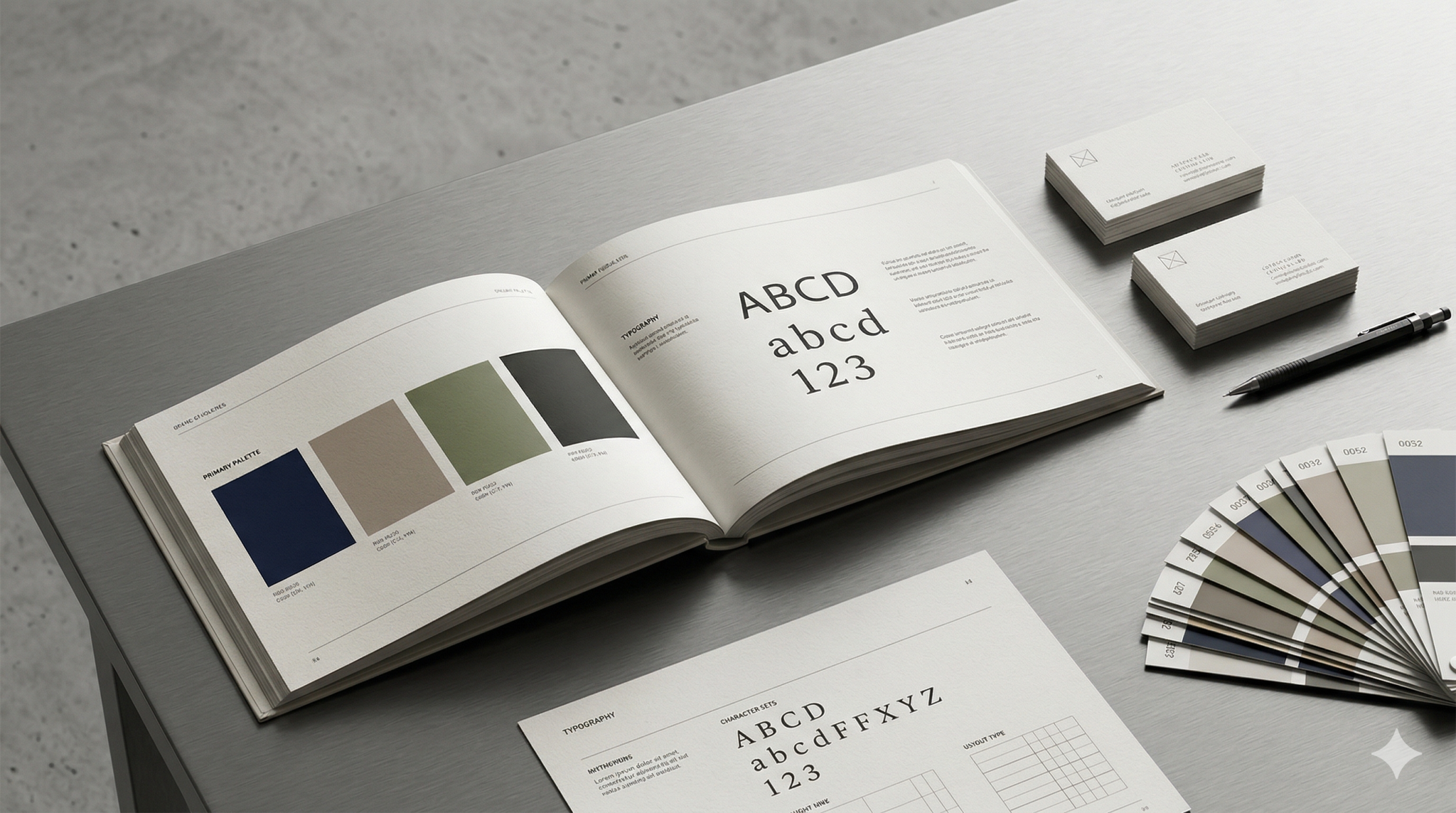
Brand guidelines are a practical document that explains how a brand should be presented. They turn brand thinking into usable rules. Rather than leaving decisions open to personal interpretation, they give teams a shared reference point for design, communication and day-to-day execution.
A good set of brand guidelines does not only show what the brand looks like. It explains how the brand behaves, how it sounds and how it should be applied in real situations. That includes everything from typography and colour usage to tone of voice, logo rules and digital asset application.
In simple terms, brand guidelines help a business answer questions like:
- Which logo version should be used here?
- How should the brand speak on social media versus the website?
- What colours, type styles and layouts are acceptable?
- How should branded assets be adapted for different formats?
Without that clarity, consistency becomes difficult to maintain. With it, the brand becomes easier to manage and easier to scale.
Why Businesses Underestimate Them
Many businesses assume brand guidelines are only needed by large organisations with multiple departments. Others see them as a static PDF that gets created once and then forgotten. That usually happens when branding is seen mainly as a visual exercise rather than an operational one.
The reality is that even small and mid-sized businesses benefit from clear rules. As soon as more than one person is involved in creating content, building presentations, designing assets, updating a website or posting on social media, variation starts to creep in.
That variation often seems minor at first. A slightly different tone here, a stretched logo there, an off-brand social post somewhere else. Over time, those inconsistencies make the brand feel less clear, less professional and less recognisable.
Businesses also tend to underestimate how often brand decisions happen outside formal design work. Sales teams use brand assets. Marketing teams write copy. External suppliers create artwork. Developers build web pages. Social teams publish content. If each person interprets the brand differently, the output quickly becomes fragmented.
Brand guidelines matter because they reduce unnecessary guesswork. They make it easier for everyone involved to execute with more confidence and more consistency.
What Good Brand Guidelines Usually Include
Strong brand guidelines are not bloated for the sake of looking impressive. They are useful, clear and built around real application. The best ones help both internal teams and external partners understand how to use the brand correctly in everyday work.
Visual Rules
Visual identity rules form the core of most brand guidelines. These sections define the system behind the look of the brand and show how it should be applied consistently.
This usually includes:
- Logo versions and approved use cases
- Brand colours and colour hierarchy
- Typography choices and usage rules
- Layout principles
- Graphic devices, iconography or illustration styles
- Photography direction where relevant
The goal is not to restrict creativity for no reason. It is to create a recognisable visual structure that can be repeated across channels without losing coherence.
When visual rules are missing, brands often drift. Social posts start looking unrelated to the website. Presentation decks do not match sales materials. Campaign assets feel disconnected from the wider identity. Clear visual identity rules prevent that fragmentation.
Tone of Voice
A brand is not only visual. It also speaks. Tone of voice guidelines help define how the brand should sound in different contexts, while still feeling consistent.
This section often covers:
- Brand personality in language
- Writing principles
- Preferred vocabulary
- Phrases or wording to avoid
- Examples of headline, body copy and CTA style
- Adjustments for different channels or audiences
Tone of voice guidelines are especially important when multiple people create content. Without them, one page may sound formal and technical while another sounds casual and promotional. That inconsistency affects trust just as much as visual inconsistency.
When businesses think of brand guidelines only as design rules, they miss a major part of what brand clarity actually involves.
Logo Usage
Logo rules are one of the most practical parts of any brand guide. They protect one of the brand’s most recognisable assets and prevent common mistakes that weaken professionalism.
A clear logo section should explain:
- Which logo versions exist
- When to use each version
- Minimum sizing
- Clear space requirements
- Acceptable background usage
- What not to do
Misused logos are still one of the most common branding problems. They get stretched, recoloured, placed on weak backgrounds or used inconsistently across digital and print assets. These details may seem small, but they influence how polished and reliable the brand feels.
A good logo usage section removes ambiguity and makes it easier for teams to get these fundamentals right.
Asset Application
This is where brand guidelines become especially useful. Asset application sections show how the brand works in real-world formats, not just in principle.
This can include examples for:
- Social media graphics
- Website banners and page layouts
- Presentation templates
- Stationery
- Packaging
- Digital ads
- Email headers and marketing assets
These examples bridge the gap between theory and execution. They show teams how the brand should behave once it leaves the brand deck and enters everyday use.
This part is often what turns a brand guide from a reference document into a working tool. It helps people apply the brand faster, with fewer mistakes and with better alignment across channels.
What Happens Without Clear Guidelines
When a business has no clear brand guidelines, inconsistency becomes the default. That inconsistency can show up visually, verbally and structurally across the entire brand experience.
Common signs include:
- Different logo styles appearing across materials
- Colours and typography changing from one asset to another
- Website and social content feeling disconnected
- Sales materials that do not match the broader identity
- Mixed messaging and tone across channels
- External suppliers making brand decisions without enough direction
The result is not just aesthetic inconsistency. It creates practical inefficiency. Teams spend more time second-guessing decisions. Feedback loops get longer. New assets take longer to approve. Brand execution becomes slower and less reliable.
There is also a credibility issue. Consistency helps audiences recognise and trust a business more easily. When every touchpoint feels slightly different, the brand can appear less established or less considered, even if the business itself is strong.
In other words, a lack of guidelines does not create freedom. It creates confusion.
When a Business Needs a Brand Guide Most
In reality, most businesses benefit from having brand guidelines earlier than they think. The need becomes especially clear at moments of growth, change or increasing complexity.
A business usually needs a brand guide most when:
- It has more than one person creating branded assets
- It works with freelancers, agencies or external suppliers
- It is launching a new website or digital platform
- It is scaling content across social, email or paid channels
- It is expanding its product or service offering
- It has recently rebranded or refined its identity
- It wants to improve branding consistency across customer touchpoints
Brand guidelines are not only for large corporations. They are useful for any business that wants brand execution to feel more controlled, more efficient and more coherent.
They are also especially valuable after a visual identity project. Without a clear brand guide, even a well-designed identity can quickly lose structure once different teams start using it.
FAQs
What is the difference between a brand guide and brand guidelines?
The terms are often used interchangeably. In most cases, a brand guide is the document itself, while brand guidelines are the rules and principles inside it.
Do small businesses need brand guidelines?
Yes. Even smaller businesses benefit from clear rules once more than one person is involved in content, design, marketing or communication. Guidelines help keep execution aligned and reduce avoidable inconsistency.
Are brand guidelines only about design?
No. Good brand guidelines usually cover both visual identity rules and communication standards, including tone of voice guidelines, messaging direction and real application examples.
How detailed should brand guidelines be?
They should be detailed enough to support real use, but not so complex that nobody refers to them. The right level depends on the size of the business, number of channels and range of assets being produced.
When should brand guidelines be created?
Ideally, they should be created as part of a branding or identity project, not added much later as an afterthought. The sooner rules are documented, the easier it is to maintain consistency from the start.
Final Thoughts
Brand guidelines matter because they make branding usable. They turn ideas, design decisions and communication principles into something teams can actually work with. That makes them far more than a nice-to-have document.
A strong brand guide helps protect consistency, improve decision-making and support better execution across design, content, digital channels and external collaboration. It keeps the brand clearer not only for audiences, but also for the people responsible for building it.
If your business is growing, creating more content or working across more touchpoints, clearer brand guidelines can make a noticeable difference. It is often one of the simplest ways to improve consistency across teams and channels without adding unnecessary complexity.v