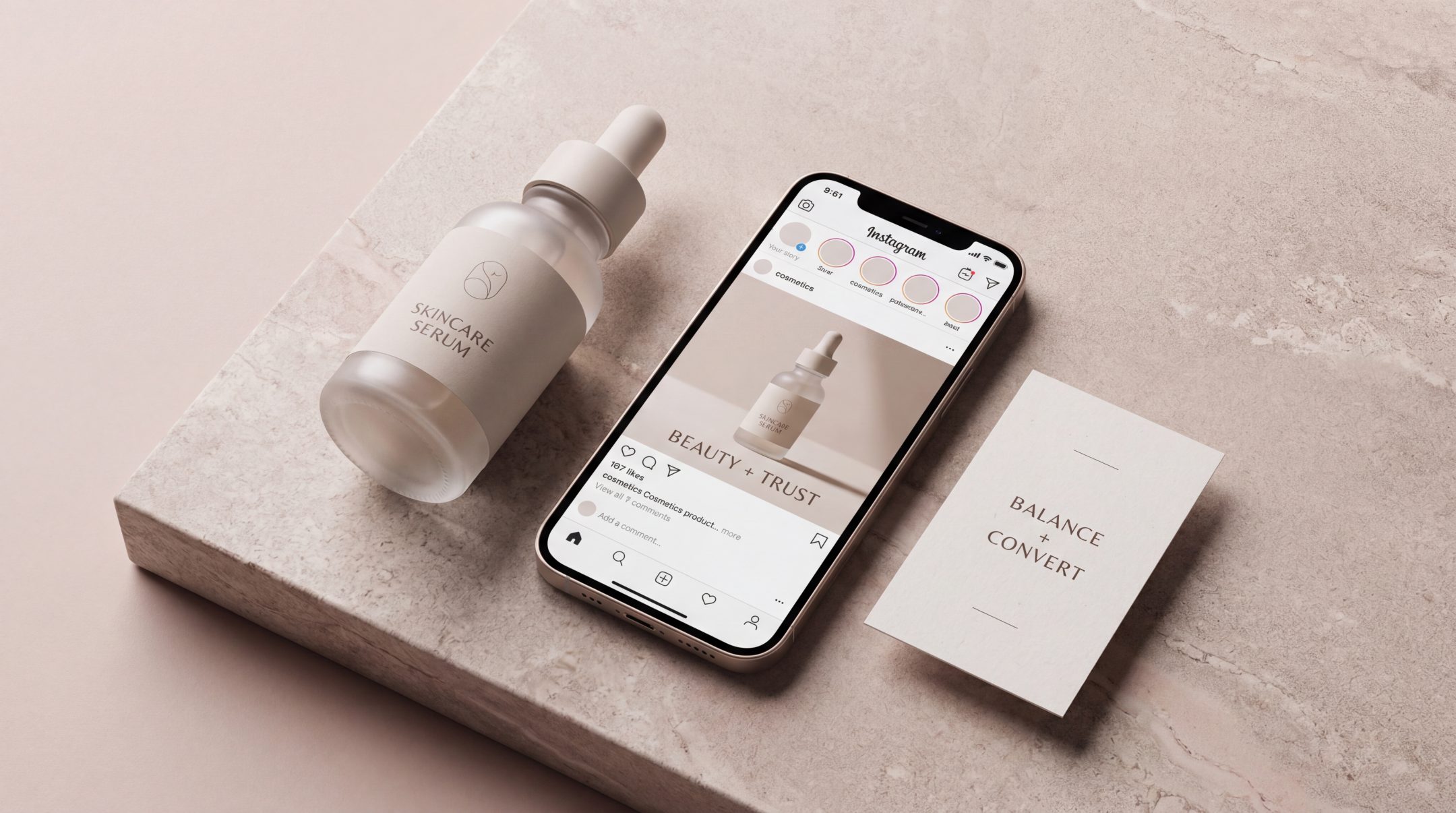
In cosmetics, social content often shapes first impressions before a customer ever touches the product. Strong content needs to do more than look attractive. It should create desire, build trust, explain value and guide people toward action in a way that still feels consistent with the brand.
Why Social Content Matters So Much in Cosmetics
Cosmetics is a category where people buy with both emotion and judgement. They respond to visual appeal, but they also look for reassurance. They want to know what a product does, how it fits into their routine, whether it feels credible and whether the brand understands their expectations.
That makes social media for beauty brands especially demanding. Content has to work on several levels at once. It needs to feel polished enough to support premium perception, clear enough to reduce hesitation and structured enough to support conversion.
Unlike some categories, cosmetics also lives very naturally on social platforms. Texture, packaging, colour, finish, routine, ritual and identity all translate well into visual content. That creates opportunity, but it also creates pressure. If every post aims only for beauty, the brand can become shallow. If every post becomes too educational, the feed can lose energy. If every post pushes too hard to sell, trust can weaken.
A strong cosmetics content strategy is really about balance. The best-performing brands usually combine visual desirability with useful information and a consistent brand point of view.
Best Practice 1: Build a Recognisable Visual Language
One of the biggest strengths a cosmetics brand can develop is instant recognisability. In crowded feeds, people should be able to identify your content quickly, even before they see the handle.
A recognisable visual language usually comes from consistency in a few core areas:
Colour and tonal control
Beauty brand content often succeeds when it uses a deliberate visual palette rather than constantly changing style. That does not mean every post has to look identical. It means there should be an obvious relationship between posts through colour balance, lighting mood, background treatment or editing approach.
For premium skincare, this might mean a clean, calm and minimal treatment. For colour cosmetics, it could mean more contrast, energy and bolder visual framing. What matters is that the aesthetic supports the product category and the intended brand perception.
Product presentation
The way products are shown should also follow consistent logic. Some brands lead with editorial beauty imagery. Others prioritise pack shots, texture close-ups or routine-led demonstrations. The strongest beauty social media strategy is not random here. It chooses a presentation style that reflects the brand and repeats it with enough discipline to become familiar.
Layout and content rhythm
Social content for cosmetics brands often includes a mix of static visuals, carousels, short-form video, routine explainers, ingredient stories and social proof. That variety is useful, but it still needs structure. A feed should not feel like different brands are posting on alternate days.
Clear layout patterns, recurring content types and consistent graphic rules help create cohesion without forcing every asset into the same template.
Best Practice 2: Explain the Product Without Overloading the Audience
Many cosmetics brands struggle with explanation. Some say too little and leave people unsure what the product actually does. Others try to include every feature, ingredient and benefit in a single post.
Neither approach works particularly well.
Strong cosmetics content strategy focuses on clarity, not volume. Social content should answer the next most important question, not every possible question at once.
Prioritise the main message
Each piece of content should have a clear communication role. Is the post introducing the product? Showing texture? Explaining a benefit? Clarifying the difference between variants? Addressing a concern? Supporting launch momentum?
When the objective is clear, the content becomes easier to shape. Instead of listing six benefits, a post might focus on one key result and support it with clean, concise language. Instead of over-explaining a formula, a short video might demonstrate how it fits into a routine.
Make complexity easier to absorb
Beauty products often involve terminology, ingredients and claims that can become dense very quickly. Social is rarely the place for full technical explanation. It is the place to make the product easier to understand.
That may mean:
using carousels to break down information step by step,
pairing product visuals with one clear benefit statement,
showing usage in context rather than describing it abstractly,
or separating education into multiple pieces of content rather than forcing everything into one asset.
A good rule is simple: reduce friction, do not increase it.
Best Practice 3: Keep the Tone Useful, Not Just Aspirational
Cosmetics branding often leans into aspiration, and that makes sense. Beauty is tied to identity, self-expression, ritual and emotion. But tone becomes weaker when it only performs a lifestyle fantasy and never helps the audience make a decision.
Useful content tends to build trust faster.
A strong tone of voice in beauty content should still feel elevated and brand-appropriate, but it should not become vague, over-styled or empty. If a caption sounds polished but says very little, it may create surface-level appeal without strengthening confidence.
Use language that supports decision-making
People often come to beauty content with practical questions in mind. They want to know:
Will this suit me?
What does it help with?
How do I use it?
Where does it fit in my routine?
Why is this product different?
The tone does not need to sound clinical to answer those questions. It just needs to be clear, calm and relevant. A cosmetics brand can still feel premium while speaking directly and intelligently.
Balance aspiration with credibility
Aspirational content is most effective when it is supported by substance. That substance could come through product education, realistic demonstrations, routine guidance, texture visibility, packaging detail or helpful comparison content.
In other words, the brand should not only tell people how to feel. It should help them understand what they are seeing and why it matters.
Best Practice 4: Connect Beauty Storytelling With Clear Next Steps
One of the most common gaps in social media for beauty brands is weak transition from attention to action. A post may look strong and reinforce the brand well, but it does not help the audience take the next step.
Storytelling matters in cosmetics because products are often sold through mood, ritual and perception. But storytelling should still connect to commercial clarity.
Make the path forward obvious
Clear next steps do not need to feel aggressive. In fact, for premium cosmetics brands, they usually work better when they feel natural and well integrated.
A next step might be:
discover the full routine,
shop the new launch,
learn more about the formula,
find your best-fit product,
or explore the full collection.
The important thing is that the content does not stop at atmosphere. It should move the viewer somewhere meaningful.
Match the CTA to the content type
Not every post should ask for a sale. Some content is better suited to education, engagement or consideration. But even then, it should still have directional value.
For example, a texture-led reel might lead to a product page. A routine carousel might lead to a collection page. An educational post about an ingredient might point toward a deeper explainer or a relevant product range.
When beauty storytelling and conversion work together, the content feels more commercially intelligent without losing its brand quality.
Best Practice 5: Use Repetition Without Making the Brand Feel Flat
Repetition is essential in social content. Brands need repeated cues, messages and formats to build familiarity. But in cosmetics, repetition can quickly start to feel lifeless if every post uses the same shot style, same caption structure and same talking points.
The goal is not constant novelty. It is controlled variation.
Repeat the right things
The elements worth repeating are usually the ones that create recognition and reinforce memory:
core visual cues,
consistent messaging themes,
brand language,
packaging presence,
and recurring content pillars.
These create stability.
Vary the way the story is told
Within that structure, brands can still introduce freshness by changing the angle. A single product can be shown through multiple useful lenses:
how it looks,
how it feels,
how it fits into a routine,
what problem it addresses,
who it is for,
or what makes it distinct within the range.
This approach keeps beauty brand content more dynamic while protecting consistency. It also helps the brand avoid becoming one-dimensional.
Common Cosmetics Social Content Mistakes
Even visually strong brands can weaken their social presence through a few recurring mistakes.
One common issue is treating social as a pure aesthetics channel. Beautiful visuals matter, but when the content never explains the product or supports decision-making, it can remain memorable without being commercially effective.
Another mistake is inconsistency. This often shows up as changing visual styles, shifting tone of voice or irregular content logic. The result is a feed that feels fragmented rather than curated.
Many brands also overload the audience with information. Long captions, dense graphics and too many claims in one asset can make content harder to engage with, not more helpful.
There is also the problem of disconnected conversion. Posts create interest, but there is no clear next step. The audience is left with awareness but little direction.
Finally, some brands become too repetitive in the wrong way. They repeat identical product shots and similar captions without adding fresh context, which can make the brand feel flatter over time.
How to Apply These Best Practices in Real Campaigns
The most effective cosmetics content strategy is not built post by post. It is built as a system.
A campaign should begin by defining a few essentials clearly:
the role of the campaign,
the audience it needs to reach,
the product questions it needs to answer,
the visual tone it needs to reinforce,
and the action it should support.
From there, content can be mapped across different functions rather than treated as one stream of similar assets.
For example, a launch campaign might include:
hero assets that establish visual desirability,
education-led content that explains usage or product benefits,
social proof or trust-building content that reduces hesitation,
and conversion-led content that directs people toward shopping or discovery.
This creates a more balanced social ecosystem. The brand does not rely on one type of post to do everything. Instead, content works together across awareness, trust and action.
For cosmetics brands in particular, this often leads to stronger results because the buying journey is rarely linear. People may discover a product through visual appeal, stay because of trust and decide because the content finally makes the value feel clear.
FAQs
What makes social content for cosmetics brands different from other industries?
Cosmetics content usually needs to balance visual desirability with explanation more carefully than many other sectors. The product has to feel attractive, but the audience also needs clarity on use, benefits, fit and credibility.
How often should cosmetics brands post on social media?
Frequency matters less than consistency and quality. A smaller number of well-structured posts with clear visual and messaging logic is usually more valuable than posting often without a coherent content system.
Should beauty social media strategy focus more on brand or conversion?
It should support both. Brand-led content helps create recognition and perceived value, while conversion-led content helps move the audience toward action. The strongest strategies connect the two rather than choosing only one.
What type of content builds the most trust for beauty brands?
Trust often grows through useful product explanation, realistic demonstrations, clear tone of voice, visible packaging and formula details, and content that helps audiences understand what a product does in real terms.
How can cosmetics brands stay consistent without becoming repetitive?
By repeating core visual and brand cues while changing the angle of each message. A product can be presented through storytelling, usage, education, comparison or routine context without losing coherence.
Final Thoughts
Social content for cosmetics brands works best when it does more than create surface appeal. It should make the brand feel desirable, understandable and commercially clear at the same time. That balance is what helps beauty content move beyond aesthetics and become a stronger driver of trust and action.
If your cosmetics brand needs social content that feels premium, useful and aligned with the way people actually discover and evaluate products, Fact & Form can help shape a content direction that supports both brand perception and commercial performance.